

The numbers vary by study, but the pattern across the serious 2025 research is consistent enough to plan around: AI adoption is racing ahead of the organizational integration, governance, and operational maturity required to turn it into value. MIT's Project NANDA, in its preliminary report The GenAI Divide, found that roughly 95% of the organizations it studied saw no measurable P&L impact from generative AI. McKinsey put more than 80% of companies in the same position on enterprise-level EBIT, with a high-performing minority of around 5% pulling away from everyone else. BCG found that 74% of firms still struggle to move beyond pilots into value, and that only about a quarter have built the capabilities to do it. EY found that nearly every large enterprise deploying AI has already absorbed a risk-related financial loss, and that the companies furthest along on governance were the ones pulling ahead. Different samples, different methods, one shape.
What stands out is where these studies put the cause. They converge on something organizational: integration, workflow redesign, and governance. McKinsey describes the work as rewiring, redesigning workflows and placing AI governance under senior ownership, and finds that value comes from how a company runs more than from the models it buys. EY treats responsible-AI governance as a performance lever, with its most governed cohort reporting stronger sales, cost, and satisfaction outcomes. NANDA names a learning and integration gap, the distance between a system that performs in a demo and one that holds up inside a real organization. Frontier models keep improving, and that matters, but across these studies the line between the few who capture value and the many who stall is organizational, not algorithmic. That gap has a structure, and once you can see it, you can architect for it.
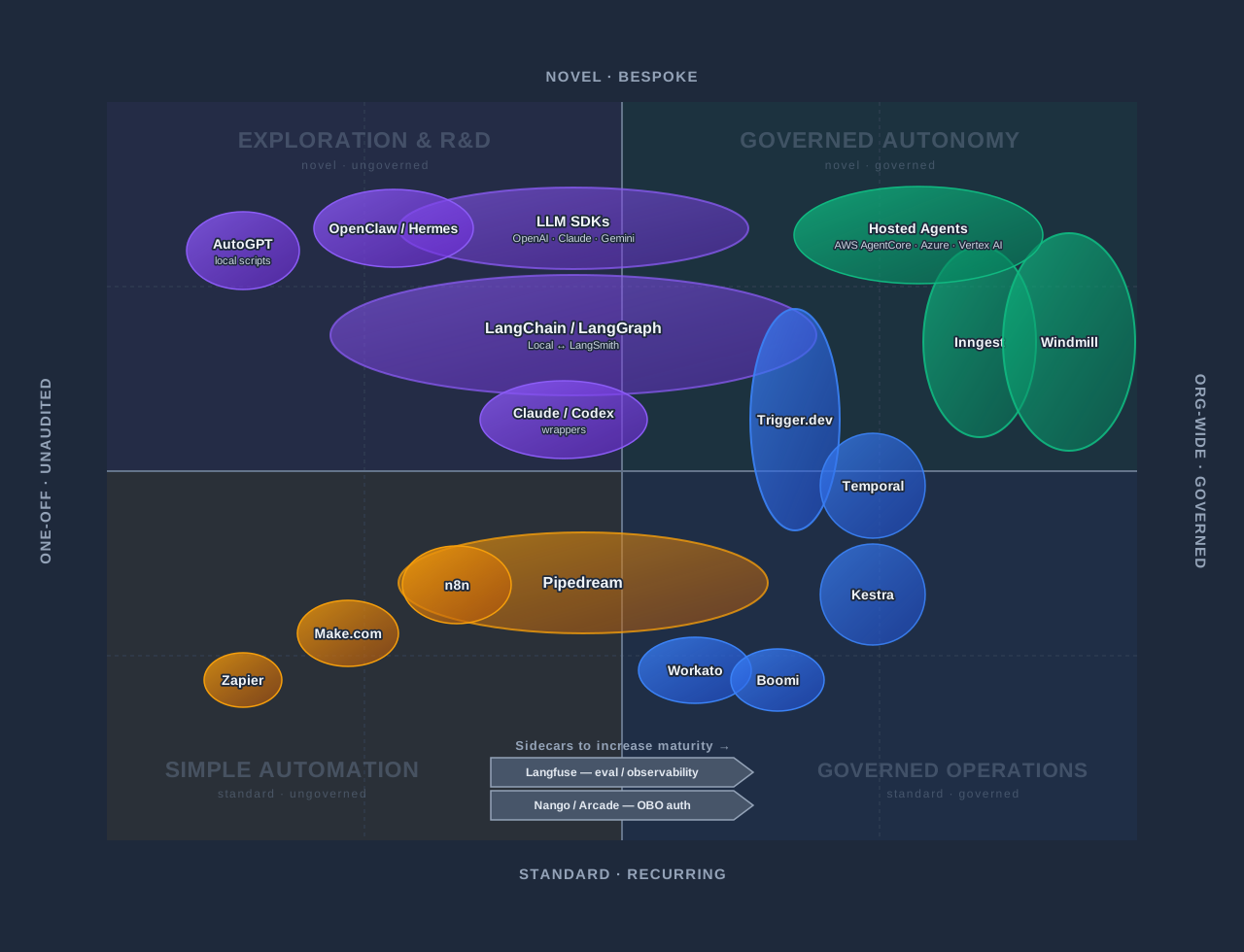
Two properties locate any automation or agentic system on a map precise enough to drive that decision: the kind of problem it solves, and the identity it is permitted to assume when it acts. Plot those two and the landscape organizes itself into four regions, each with its own economics, its own buyers, and its own route into production.
The vertical dimension describes the problem space. Toward the bottom sit standard, recurring workflows, where the inputs are known, the outputs are defined, and execution follows a fixed graph of steps. Toward the top sit novel, bespoke problems, where a system receives a set of tools and an objective and relies on a reasoning engine to discover the path on its own. Determinism governs the lower half, and open-ended reasoning governs the upper half.
The horizontal dimension describes identity, governance, and scale, and it carries most of the strategic weight, so it rewards precision. Toward the left, systems run on a single user's stored credentials, broad God-mode API keys, local scripts, and disposable demos, so that when something breaks or hallucinates the only person who learns about it is the builder. Toward the right, systems run on delegated, on-behalf-of authorization, narrowly scoped permissions, in-session authentication, comprehensive observability, and tamper-evident audit logs, which together let a system account for what it did, whose data it touched, and the proximate cause of every decision. The right-hand world is the one engineered for multiple principals and genuine production traffic.
Crossing those two dimensions produces four regions, best read as four distinct buyer segments, each with its own economics. In the lower left sits Simple Automation, where a citizen developer wires known APIs together and produces real value. Zapier and Make anchor this corner, and their enterprise tiers are more capable than they are usually given credit for, offering role-based access, audit logs, single sign-on, and managed team credentials. That governance, though, is administered inside the vendor's own multi-tenant cloud, where the credentials and the execution ultimately live. n8n sits in the same corner with one structural difference: it is source-available and self-hostable, so a team can run the same automation inside its own VPC, behind its own identity provider, audit pipeline, and data-residency boundary. That property lets n8n travel rightward across the governance axis on the organization's own terms rather than the vendor's, which is the distinction that begins to matter once a workflow has to answer to an auditor. The lower right holds Governed Operations, where enterprise integration platforms such as Workato and Boomi, together with durable-execution engines like Temporal, solve those same known problems with role-based access control, governance, and deep auditability at scale, doing so with a deliberate, almost boring consistency that turns out to be their entire value proposition.
The upper half changes character. The upper left is Exploration and R&D, the home of AutoGPT, raw model SDKs, and the LangChain script running on a laptop, where open-ended reasoning produces striking results inside an environment with effectively no guardrails, which makes it the place where capability gets discovered well ahead of the moment it becomes fit to deploy. The upper right, the hardest and most valuable region of the entire map, is Governed Autonomy, where non-deterministic reasoning operates underneath a complete audit trail, and most teams underestimate what it takes to get there.
The difficulty of that corner is structural, and it is exactly the gap this research keeps describing. Climbing the vertical dimension, from simple problems to novel ones, is a capability question, and capability grows cheaper and more abundant every month. Moving across the horizontal dimension, from ungoverned to governed, is an architecture question, and architecture questions yield only to deliberate engineering. A team reaches Governed Autonomy by building the identity, evaluation, and audit substrate that sits beneath an agent before its reasoning can be trusted in front of a customer, and that substrate is the real price of admission.
That substrate usually arrives as sidecars, and the most useful way to read them is as forcing functions, the gravity that pulls a system toward the governed side of the map. Identity layers such as Nango and Arcade retire God-mode keys in favor of scoped, on-behalf-of token exchange, so that an agent acts as a specific principal with specific permissions. Evaluation and observability layers close the loop, wrapping unpredictable behavior in measurement, auditing, and human review, which keeps guardrail degradation visible while it is still small enough to correct before it matures into foreseeable harm. The clearest example is Langfuse, open-source and self-hostable, so the same governance properties that matter for the rest of the stack extend to the evaluation layer itself; a field of proprietary platforms, Braintrust among them, occupies the same niche. An agent placed in front of a customer without that scaffolding becomes a product-liability surface with a good demo attached, which is precisely why the governed corner rewards the teams that install the substrate early.
The most interesting platforms behave as spans across this map. Pipedream extends the full width of the governance dimension, opening in quick unaudited scripting and reaching well into managed, scoped territory. Inngest and Windmill begin in deterministic, code-native orchestration and carry that reliability upward into agentic workloads. LangChain covers nearly the entire open half, from a local experiment through to governed, audited deployment under LangSmith and LangGraph. For any architecture decision, the operative question is which direction a given stack needs to stretch and what that stretch will cost in engineering and governance terms, and that question drives sounder decisions than any ranking of tools in isolation.
The implication for anyone allocating budget or making architecture decisions over the next eighteen months is direct. The organizations that capture value will be the ones that treated identity, evaluation, and audit as load-bearing architecture from the first commit, building governance into the foundation while it was still inexpensive to do, well before a customer, an auditor, or a regulator made it urgent. That is the work that carries a system from a promising pilot into production, which is where the 5% live.
I have placed these platforms on the map above where I believe they belong, and the lines are deliberately arguable. Where would you move them? Which tool is sitting one quadrant away from where your own production experience says it should be, and what does that disagreement reveal about how you read the governance axis?
Stuck on the right side of the map?
Getting an agent into the Governed Autonomy corner, non-deterministic reasoning under a complete audit trail, is the work I embed to do: identity, evaluation, and audit built into the architecture, not bolted on after a customer or regulator forces it.
Stay Updated
Subscribe for frameworks and engagement briefs on production AI, agents, and governed autonomy.