

The Landscape
Conversational AI is entering high-trust domains: healthcare, education, financial services, mental wellness. In these domains, the product's relationship with the user is ongoing, personal, and built on accumulated context. These are not search engines or chatbots answering one-off questions. They are agents that remember, adapt, and form something close to a working relationship with the people who use them.
This changes the safety problem in ways that most teams underestimate.
The inherited approach to AI safety is content moderation: a stateless classifier that evaluates each message in isolation and makes a binary decision to block or allow. That design was built for social platforms, where the threat is an adversarial user posting harmful content and the correct intervention is removal.
In high-trust domains, that model breaks down on three axes.
First, the user is not the adversary. Users in these contexts who express something concerning are overwhelmingly acting in good faith. They are the people the product was built to help. A system that responds to a moment of need with a generic refusal, or worse, a conversation termination, has not made the interaction safer. It has ended the relationship at the moment it mattered most.
Second, safety is not a per-message decision. These agents carry conversational memory. Context accumulates across turns and across sessions. A message that is entirely benign in isolation can become a risk signal when understood against the history of the conversation. A stateless classifier cannot see this. The safety system must operate with the same contextual awareness as the agent itself — it must understand where the conversation has been, not just what the current message says.
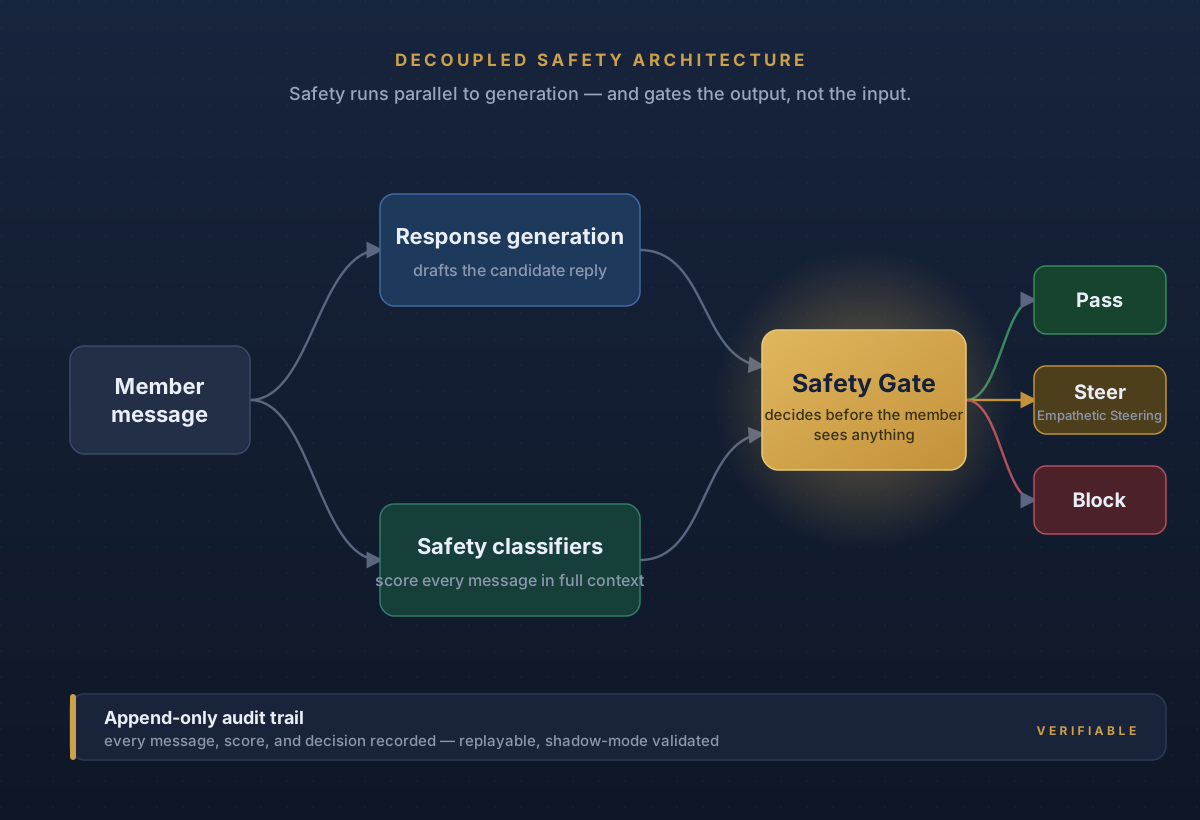
Third, the intervention must be part of the conversation, not an interruption of it. When the system identifies a risk signal, the agent's behavior needs to shift — in tone, in topic, in the resources it surfaces — while maintaining the user's trust and engagement. This is not a filter sitting alongside the conversation. It is a state change within the agent: the system becomes aware that the interaction has entered safety-relevant territory and adapts its conduct accordingly. The user should experience care, not a wall.
Getting this right is a systems-level design problem. It cannot be solved by prompt engineering, by tuning a classifier's threshold, or by appending a disclaimer. It requires purpose-built infrastructure: policy that defines what contextually appropriate means in concrete terms, architecture that gives the safety system access to the same conversational state as the agent, data infrastructure that preserves evidence while respecting privacy, and operational design that connects automated decisions to human judgment.
The Engagement
A major mental-health AI team engaged Machine Wisdom AI to strengthen safety architecture for a conversational AI companion. The product already had a serious commitment to member wellbeing. The work was to translate that commitment into engineering rigor for a system operating in a sensitive mental health context.
I was embedded with the team as a principal-level AI safety architect. The engagement focused on the parts of the system where product experience, model behavior, clinical judgment, safety policy, data architecture, and operational governance had to meet.
What I delivered:
A formal risk detection policy defining what the system detects, at what severity, and with what response. The policy makes risk categories, non-goals, severity, and scope signals explicit so safety behavior is governed rather than left to implicit model behavior.
A context-aware safety architecture that operates with access to the agent's broader conversational state, not just the current message. The architecture decouples safety governance from the core conversational system so policy, classifiers, and response logic can evolve independently.
An audit-ready data infrastructure that resolves the core tension in regulated AI: privacy law demands minimization and erasure, while safety obligations demand evidence preservation and audit trails. These mandates are in direct conflict. The resolution is architectural.
A validation methodology that treats classifier quality as an operating discipline: real-time detection, asynchronous re-evaluation, human review for disagreements, shadow-mode validation for candidates, and regression constraints before production changes.
And the operational design connecting all of it: escalation pathways, clinical quality assurance, human review protocols, and cross-functional governance for ambiguous or high-acuity cases.
The Result
The engagement helped turn safety from a collection of safeguards into an operating system: defined risk categories, context-aware response logic, defensible audit trails, measurable evaluation criteria, clinical review, and cross-functional governance.
The architecture is designed for continuity: maintainable by the client's internal teams, adaptable as requirements evolve, and extensible as the product scales.
Work with Machine Wisdom AI
Machine Wisdom AI embeds at the architecture layer to resolve the hardest trust and safety problems in autonomous AI products. The work is principal-level technical leadership inside the system: policy, architecture, evaluation, governance, and implementation support your engineering team can maintain.
A typical engagement is an ongoing fractional engagement, working directly with product, engineering, legal, and domain stakeholders. The engagement model is designed for shared operating clarity: as the engagement evolves, the client's team keeps ownership of the system while Machine Wisdom AI provides principal-level continuity across policy, architecture, evaluation, governance, and implementation decisions.
Hitting walls where agent autonomy outpaces auditability? Let's talk.
Stay Updated
Subscribe for AI safety insights and new engagement briefs.
This brief avoids unpublished metrics, client-identifying details, and implementation specifics. Machine Wisdom AI treats client confidentiality as a professional obligation.